0 / 174admissible prior trials improve head and shoulders in both phases. Chest, pelvis and chair contact were absent from that objective.
Pre-event reference
Current source frame
Colored: passes tracking/review checks. Red: rejected; ambiguous collar seed excluded throughout. These are image appearance features, not recovered bones. Review-only; not used to fit forces.
Observed vertical image motion
Upward in this camera, in stabilized pixels. Gaps stay missing. No millimeter conversion or 3D inference.
One shared trajectory, viewed from front and side. Compare head-only with articulated neck + head. Yellow circle: source. Pink square: preserved model. Mint diamond: experiment.
Solid: head. Dashed: neck. These are conditional fitted controls, not measured skull or cervical-joint rotation. Nose and ear observations cannot uniquely separate all head/neck movements.
Used points versus points left out
View
Frames
Count
Before, px
After, px
Reference-relative displacement RMS in stabilized pixels. Alternating source labels were withheld from this correction; the original model has historical exposure to this sequence. This is an internal check, not independent validation. Source-point covariance is included in the fitting objective; these display RMS values are unweighted.
Experimental correction only; the primary twin remains unchanged. A motion fit does not identify forces.
The preserved fit follows much of the nose movement, but misses its placement. Compare source observations with the earlier kinematic fit.
Magenta square: earlier fit. Yellow circle: source review. Switching views selects the nearest available source time.
Cyan: rightward. Orange: downward. Solid: observed. Dashed: earlier fit. Each starts at its own first source frame; missing observations stay missing.
Projected head-feature orientation
Cyan ear region + yellow nose region. Their connecting line changes orientation, but localization uncertainty remains substantial.
Cyan: observed segment angle change. Shading: working localization range. Dashed magenta: earlier model's generic nose–ear proxy; anatomical sites are unmatched. Positive means nose downward relative to ear in the image. No precise 3D skull rotation established.
Training frames only; same-AI source annotations. Working tolerances, timing and stabilization remain provisional. Front and side tip regions may differ in material identity. This is a historical kinematic comparison, not a validated head rotation or an impulse simulation.
Three later test frames, reviewed after predictions were frozen. Optical flow: 3/3 retained, 3.99 native-pixel RMS disagreement. Reference template: 0/3 retained.
Only three adjacent frames in one camera. New labels were withheld from the tracker; historical source exposure remains. Regional agreement does not establish anatomical accuracy.
Six source frames. Yellow: current boundary. Magenta: starting boundary, aligned through the inherited camera stabilization. Short green lines measure change perpendicular to the starting boundary.
Cyan: image-left shoulder. Orange: image-right. Positive is outward/upward along the starting boundary’s normals, in stabilized pixels. Shading is a working localization range. Gaps mean insufficient contour overlap.
These are garment outlines, not measured joints or tracked fabric vertices. Timing and stabilization remain provisional; sparse frames do not establish precise onset. No body/force fit used these observations.
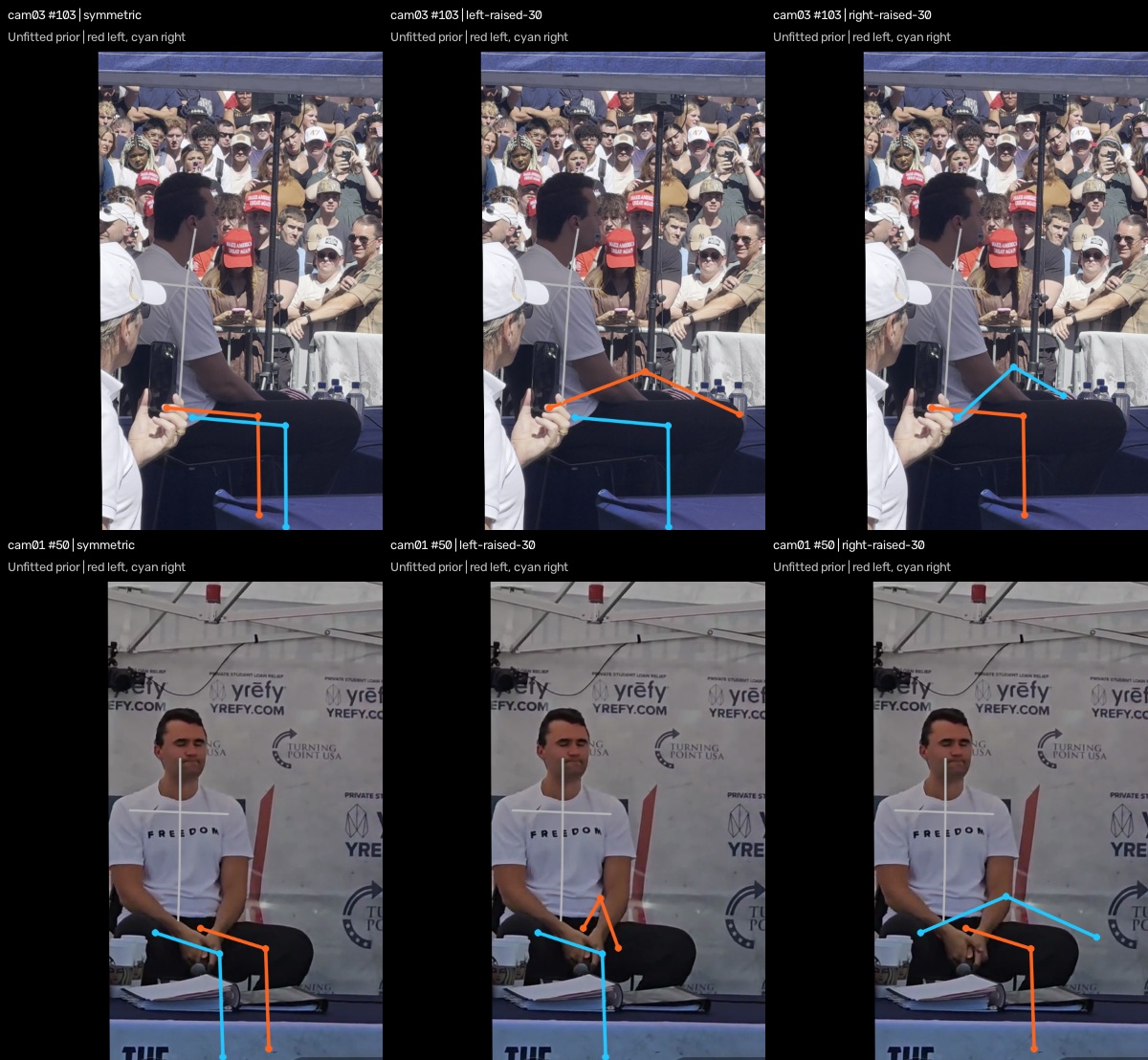
Source: asymmetric raised/crossed leg. Current trial: symmetric leg priors and two possible floor contacts. Hidden foot and seat contacts remain unknown.
Compare starting-posture alternatives
Red: model left leg. Cyan: right. These are model joint centers, not observed points; foreground occlusion is not masked. None is accepted as the source posture.
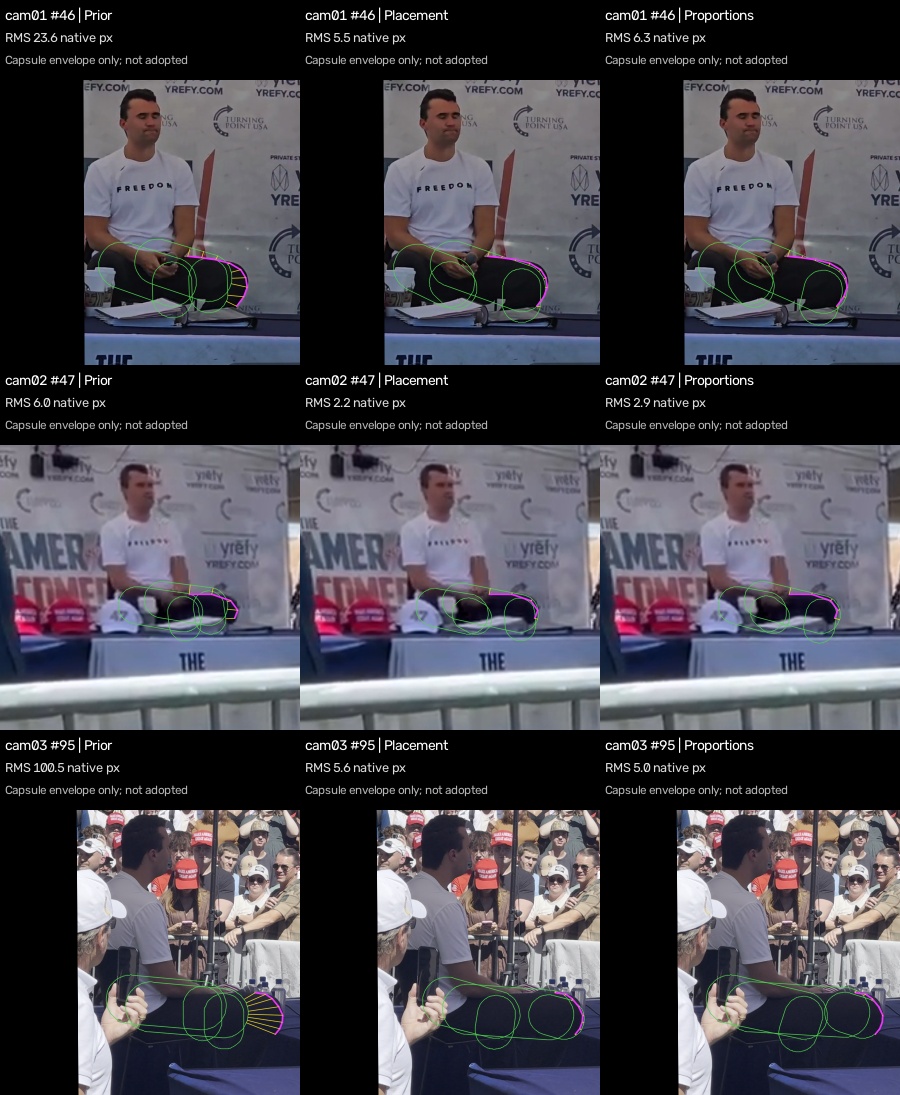
Two different body assumptions fit the same 22 pre-event pants-outline points much better. Both pass the limited capsule-overlap check; neither establishes the actual anatomy.
Green: model clothing envelope. Magenta: reviewed source outline. Yellow: residual.
Training comparison only. Cameras, scale, hidden joints and supports remain provisional. These fits have not replaced the mechanical simulation.
Nine no-load checks. Largest settled posture change: 2.6 mm across these assumed variations. The default left foot lifts about 0.14 mm clear of the floor; zero floor load is therefore expected. Softer contact shows intermittent back-load release.
Variation
Pose change, mm
Left foot gap, mm
Back contact
Mean back load, N
Positive foot gap means separation. Dimensions and mass remain provisional. These are chosen sensitivity ranges, not measured confidence bounds; no impact was fitted.
Fit the outline and the supports together
New constrained candidates settle about 5–8 mm, versus 85–151 mm before. Both touch the assumed contact tolerance; anatomy remains unverified. The proportion candidate has one sampled back-contact dropout at the coarser timestep.
Fitted starting outline
After gravity + contact
Magenta: source pants outline. Cyan: starting model envelope. Orange: simulated envelope. Scrubber shows 0–4.4 seconds of settling, not video event time. No impulse. Cameras, dimensions and 100 kg mass remain assumptions. Source frames near −205 ms; constant pre-event posture is unverified.
Both outline alternatives start with a foot below the fixed floor. They settle away from the fitted pose. Neither is accepted for impulse trials.
Fitted starting outline
After gravity + contact
Magenta: source pants outline. Cyan: starting model envelope. Orange: simulated envelope. Scrubber shows 0–4.4 seconds of settling, not video event time. No impulse. Cameras, dimensions and 100 kg mass remain assumptions. Source frames near −205 ms; constant pre-event posture is unverified.
Prior broad-load sweep, diagnostic re-ranking only. Each cell is error ÷ no-impulse error; below 1 is better. No new loads were fitted. No independent validation is claimed.
Prior case
Early head
Early shoulders
Later head
Later shoulders
Evidence and next steps
63 native-derived frames from three views. Existing timing and scene stabilization are provisional. Cam06 is reserved from the next fitting stage but has prior historical exposure. Pixel tracks use assistant-selected seeds and forward/backward consistency; this does not establish anatomical identity or accuracy.
Next: verify feature identities through the sequence; map appropriate observations to anatomy; correct initial limb/contact hypotheses; fit both phases; check excluded observations before higher-fidelity body simulations.